



Google Ads vs Meta Ads: Which Is Right for Your Business?
 Paid MediaSep 18, 20264 Min Read
Google Ads and Meta Ads are two of the most widely used digital advertising platforms, but they reach customers in different ways.
Google Ads is particularly useful for capturing existing demand, while Meta Ads is strong at generating awareness and reaching people before they actively search. For many businesses, the right strategy is not choosing one platform permanently, but understanding where each fits within the customer journey.
Here’s how they compare.
What Is the Main Difference Between Google Ads and Meta Ads?
The biggest difference is user intent.
With Google Ads, businesses can reach people while they are actively searching for a product, service, or solution. Someone searching for “personal trainer in Barcelona,” for example, is already expressing a clear need.
Meta Ads works differently. Ads appear across platforms such as Facebook and Instagram while users browse content. Instead of relying primarily on a search query, advertisers can reach potential customers using audience signals and Meta’s advertising systems.
In simple terms:
- Google Ads: Capture existing demand.
- Meta Ads: Generate and develop demand.
- Google Search: Strong when users already know what they need.
- Meta: Strong when the product or brand benefits from discovery and visual presentation.
When Should You Use Google Ads?
Google Ads makes sense when potential customers are already searching for what your business offers.
Search campaigns allow businesses to appear for relevant queries at the moment someone is researching a product, comparing options, or looking for a provider.
Google Ads also goes far beyond Search. Depending on the business and objective, advertisers can use Shopping, Performance Max, Display, YouTube, and Demand Gen campaigns.
Google Ads can be particularly useful when you want to:
- Generate leads from high-intent searches.
- Drive online sales.
- Promote products through Shopping campaigns.
- Reach customers searching for local services.
- Capture demand that already exists.
For example, a user searching “emergency plumber near me” has much stronger immediate intent than someone who happens to see a plumbing company while browsing social media.
That intent is one of Google Ads’ biggest advantages.
When Should You Use Meta Ads?
Meta Ads is particularly useful when customers are not necessarily searching for your product yet.
Facebook and Instagram allow brands to introduce products and services through visual formats such as images, videos, Stories, Reels, and carousel ads.
Meta Ads can be useful when you want to:
- Build brand or product awareness.
- Introduce a new product to potential customers.
- Reach new audiences.
- Promote visually appealing products.
- Generate leads or sales through social advertising.
- Re-engage people who have previously interacted with your business.
This makes Meta especially relevant for businesses where visual discovery influences purchasing decisions, including fashion, beauty, fitness, home products, and many e-commerce categories.
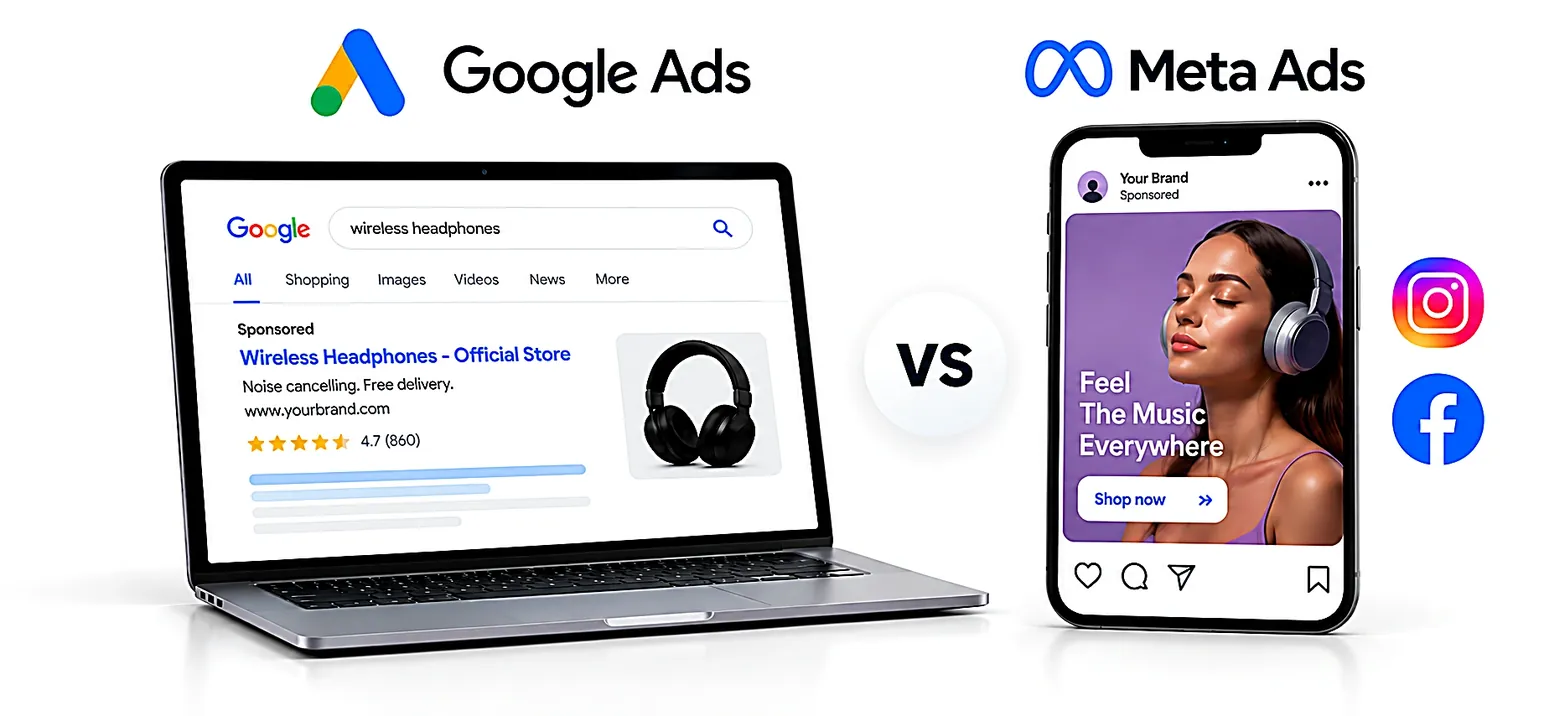
Google Ads vs Meta Ads: Key Differences
 Google Ads
 Meta Ads
The distinction isn’t absolute. Both platforms now use extensive automation, machine learning, and audience signals, and both can generate leads and sales.
The more useful question is where your customers are in their buying journey when you want to reach them.
Which Platform Is Better for E-commerce?
For many e-commerce businesses, using both Google Ads and Meta Ads can cover different stages of the buying journey.
Imagine an online furniture store.
A customer might first discover a lamp through an Instagram ad. They don’t purchase immediately. Several days later, they search Google for the product category, compare alternatives, and eventually make a purchase.
In this scenario:
Meta created the initial discovery → Google captured the later intent.
Attribution will not always follow such a simple path, but the example demonstrates why evaluating advertising channels completely independently can give an incomplete picture of how customers actually buy.
Can You Use Google Ads and Meta Ads Together?
Yes. In many cases, the platforms can complement each other rather than compete for the same role.
A simple customer journey could look like this:
Meta Ads → Awareness → Google Ads → Search → Remarketing → Conversion
This means Meta can introduce the product, Google can capture later search intent, and remarketing can help reconnect with users who have already shown interest.
The exact mix should depend on your product, margins, customer journey, available creative assets, tracking setup, and advertising budget.
So, Google Ads or Meta Ads?
Start with the customer’s behavior, not the advertising platform.
If people are already searching for the solution you provide, Google Ads gives you an opportunity to capture that existing demand.
If customers need to discover your product, understand why they need it, or see it before considering a purchase, Meta Ads can help create that demand.
And if customers both discover and search before converting, using Google and Meta together can provide coverage across more of the buying journey.
The key is not simply being present on both platforms. It is giving each platform a clear role and measuring whether that role contributes to business results.
More from our blog
Practical guides on Google Ads, Meta Ads and growth marketing.
 Google Ads8 Min Read
Google Ads Optimization: 10 Ways to Improve the Performance
Improve Google Ads performance with 10 practical optimization strategies covering tracking, traffic, bidding, budgets, conversions and ROAS.
Google Ads8 Min Read
Google Ads Optimization: 10 Ways to Improve the Performance
Improve Google Ads performance with 10 practical optimization strategies covering tracking, traffic, bidding, budgets, conversions and ROAS.
 Tracking7 Min Read
Google Ads Conversion Tracking: Why Running Ads Without It Wastes Budget
Google Ads conversion tracking shows which clicks become customers. Learn what it is, what happens without it, and how to check your setup is working.
Tracking7 Min Read
Google Ads Conversion Tracking: Why Running Ads Without It Wastes Budget
Google Ads conversion tracking shows which clicks become customers. Learn what it is, what happens without it, and how to check your setup is working.
 Targeting9 Min Read
Meta Ads Targeting Guide: Advantage+, Interests & Audiences
Learn how Meta Ads targeting works in 2026, including Advantage+ Audience, interest targeting, Custom Audiences, Lookalikes and audience strategy.
Targeting9 Min Read
Meta Ads Targeting Guide: Advantage+, Interests & Audiences
Learn how Meta Ads targeting works in 2026, including Advantage+ Audience, interest targeting, Custom Audiences, Lookalikes and audience strategy.